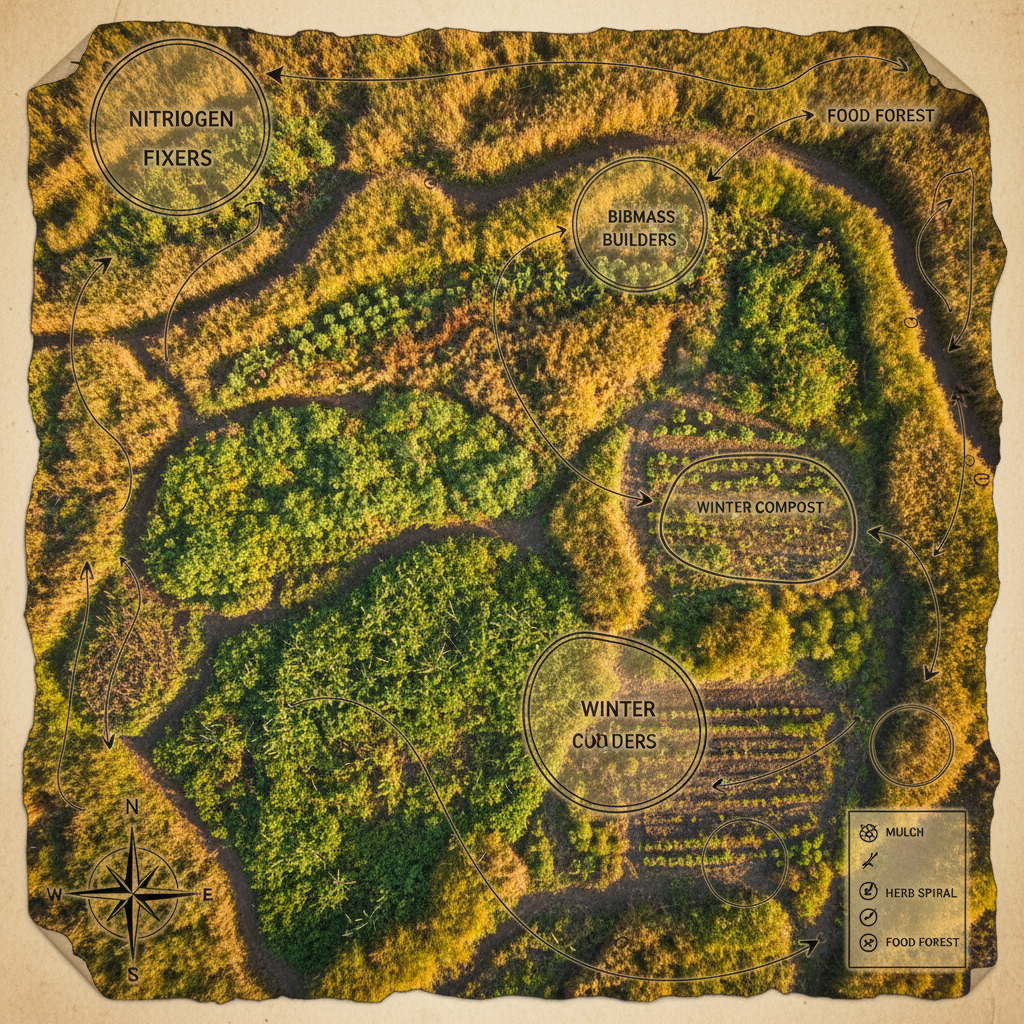
Native Cover Crops Mapping: Winter Soil Prep Guide
Imagine staring at your garden in late fall. The soil lies exposed, cracked from summer's heat, vulnerable to winter rains and winds that wash away precious topsoil. You've poured effort into your permaculture design, but without protection, that hard-won fertility slips away.
Now picture this: A living blanket of native cover crops thriving across your zones, holding soil in place, fixing nitrogen, and feeding soil life through the coldest months. No synthetic fixes—just plants adapted to your place, stacking functions like erosion control, pest distraction, and future mulch. This is winter soil prep made simple and ethical.
As a beginner planner, mapping native cover crops lets you observe your site, design with succession in mind, and celebrate small wins. You'll end winter with richer soil, ready for spring abundance. Let's turn that vision into your reality.
What Are Native Cover Crops and Why Map Them in Permaculture?
Native cover crops are plants from your local ecosystem, sown to cover bare soil during off-seasons like winter. Think legumes, grasses, and brassicas evolved right in your bioregion—no imports needed.
In permaculture, they shine by embodying core principles. They observe and interact with your site's microclimates. They stack functions: preventing erosion, building organic matter, suppressing weeds, and attracting beneficial insects. Natives especially use and value diversity, supporting pollinators and soil microbes adapted to your soils.
Why winter soil building? Cold months are prime for roots to deepen and decompose, adding humus without competing with food crops. Mapping them ties into zone planning—intensive Zone 1 gets quick-growing covers, while outer zones use perennials for edges.
Most importantly, natives align with earth care ethics. They're resilient to local pests and droughts, reducing inputs. For homesteaders and suburban gardeners, this means low-effort fertility that scales from backyard to small farm.
Skip exotics that might escape or fail in your climate. Mapping natives starts with your permaculture map—a simple sketch revealing where each species thrives best.
Observe and Sketch Your Permaculture Map for Native Covers
Start by grabbing paper and pencil. Your permaculture map isn't fancy software—it's your site's story, drawn from observation.
Walk your property over a week. Note slopes, wind patterns, wet spots, and sun exposure. Mark Zone 1 (house veggie beds), Zone 2 (orchard/main crops), up to Zone 5 (wild edges).
Why zones? They guide energy efficiency. Zone 1 needs frequent-access covers like low clover. Zone 5? Tough prairie grasses that self-sustain.
Action steps:
- Draw a bird's-eye view: North arrow, scale (even rough).
- Shade microclimates: Sunny south slopes vs. shady north.
- List soil types per area—clay? Sandy? Test by feel.
Incorporate edges principle: Where zone meets zone, plant mixed covers for maximum yield. A Zone 1-2 edge might blend nitrogen-fixers with deep-rooted grasses.
Observe locals: What greens up in fall/winter nearby? Apps or extension services list natives by zip code. For example, in eastern U.S., note Trifolium arvense (rabbitfoot clover) in fields.
Your map now whispers: "Here, erosion risks high—prioritize dense covers." This timeless tool turns planning into action.
Spend 30 minutes daily observing. Adjust the map. Celebrate patterns emerging—you're interacting with your land.
Select Native Cover Crops by Zone and Function
Choosing natives means matching plants to your map's realities. Focus on winter-hardy species that obtain a yield—soil fertility as the harvest.
Zone 1: Intensive, frequent harvest areas (beds near kitchen). Pick low-growers for easy mowing. Trifolium repens (white clover), native-naturalized nitrogen fixer, tolerates foot traffic. Mix with Festuca rubra (red fescue), a cool-season grass for quick cover.
Stack functions: Clover feeds soil microbes; fescue prevents compaction. Sow 10 lbs/acre clover seed.
Zone 2: Main annual/perennial crops. Deeper roots here. Vicia sativa (common vetch), a winter annual legume, climbs and smothers weeds. Pair with Lolium perenne (perennial ryegrass, native ecotypes) for biomass.
In Midwest, try Desmodium canadense (tick trefoil) for pollinators. Expect 20-30% nitrogen boost.
Zone 3: Orchards, pastures. Perennial mixes shine. Schizachyrium scoparium (little bluestem) holds slopes; Elymus canadensis (Canada wildrye) for grazing potential.
Zones 4-5: Woodlands, wild areas. Let succession rule. Carex pensylvanica (Pennsylvania sedge) under trees; brassicas like Brassica nigra (black mustard, naturalized) for chop-and-drop.
Regional tips:
- Pacific Northwest: Festuca idahoensis (Idaho fescue).
- Southwest: Bouteloua curtipendula (sideoats grama).
- Northeast: Lotus corniculatus (birdsfoot trefoil, adapted).
Consult local native plant societies. Aim for mixes: 60% grasses, 40% legumes. Test small plots first—beginner wins build confidence.
Planting Native Cover Crops: Timing and Techniques
Fall is your window—soil above 50°F (10°C), 4-6 weeks before hard frost.
Prep soil: Lightly till or no-till. Rake smooth. Your map guides: Slopes get erosion-focused mixes.
Methods:
- Broadcast seeding: Hand-scatter for small areas. Zone 1 beds: 1-2 lbs/1000 sq ft. Rake in lightly.
- Drill seeding: For larger Zone 2-3, rent a seeder. Depth 1/4-1/2 inch.
- Mulch integration: Overseed into existing mulch, roll for contact.
Incorporate relative location: Sow near water sources for irrigation if dry fall.
Rates example: Vetch 15-20 lbs/acre; clover 8-10 lbs/acre. Mixes halve rates.
Water gently post-planting. In mild winters, they'll green up fast.
Beginners: Start with 100 sq ft test plot matching your map. Track growth in a journal—observe responses to weather.
Managing and Transitioning Winter Covers to Spring
Winter isn't hands-off, but minimal work yields big.
Monitor: Weekly checks per zone. Mow tall growth in Zone 1-2 to 4-6 inches—stack as mulch.
Weed control: Natives outcompete naturally. Hand-pull invaders.
Boost soil life: Add compost tea if thin snow cover.
Spring transition uses succession principle:
- Early March (or 2 weeks pre-last frost): Mow/crimp covers.
- Zone 1: Till under clover for quick beds.
- Zone 2: Roll-kill vetch, direct-seed tomatoes into residue.
- Outer zones: Let perennial covers persist, interplant.
Harvest biomass: Chop-and-drop adds 2-4 tons/acre organic matter.
Troubleshoot: Poor germination? Reseed wet spots. Pests? Diversity deters.
Your map evolves—note successes for next year.
Key Takeaways
- Map first: Sketch zones and microclimates to place native cover crops precisely, aligning with permaculture observation.
- Choose natives wisely: Legumes like Vicia sativa and grasses like Festuca rubra stack soil-building functions across zones.
- Plant in fall: Use broadcast or drill methods 4-6 weeks pre-frost for winter protection and spring fertility.
- Manage minimally: Mow for mulch, transition via succession to boost yields ethically.
- Celebrate ethics: Natives honor earth care, diversity, and limits—perfect for beginner homesteaders building resilience.
These steps turn bare winter soil into a living asset, saving you work while growing abundance.
Next Steps
- Observe your site today—sketch a rough zone map.
- Research 3-5 local natives via native plant finder or extension office.
- Order seeds for a 500 sq ft test area.
- Sow by mid-October; journal progress.
Your first mapped covers will inspire the full design. You've got this—soil health starts now!
Curated by
Daniel Crawford
Regenerative Systems Designer